As part of my modernization theme, I ask kids to take a look at the issues behind the most ubiquitous item in modern day life - the cellphone (and tablet and soon-to-be watch). For the purpose of this mini-unit we focus exclusively on Apple products, although I stress that much of what they learn can be found in products made by other companies.
They begin by reading links and watching videos about rare earth minerals in week one and then transition into the factories that actually make the products in week two. I try to pace this so that I have a whole group discussions (the groups range in number from six to eight students) once per class to help clear up misconceptions and answer specific questions from the readings. The page with all of the materials can be found here: Gizmos.
During week three the groups begin to create their mini-documentaries using Mozilla Popcorn. I share this rubric with them, and we spend a portion of class going over all of the aspects. I provide suggestions for how to organize their work, but ultimately leave it up to each group to decide what structure works best.
When all is said and done, I end up with decent final products that I share with the other classes and teachers and parents. One of the biggest obstacles is that Mozilla Popcorn doesn't read HTML5 very well, which is the new standard format of YouTube videos. Also, as you can see below, if the owner of a video decides to remove it or make it private - you've lost it in your remix.
(Yes, I am aware - as are the students now - that the picture that starts the second video is not accurate.)
Friday, May 29, 2015

Thursday, May 28, 2015
Authenticity Is The Barrier
I could list all of the soft skills needed to create online content, but you could also just google it and find the same list. Instead I want to discuss some of the systemic roadblocks we face.
I has a casual conversation with some of my students at the end of class yesterday concerning the prompt for this module, and the common issue they brought up was confidence. They are worried about being wrong in the open. They are worried about being wrong for the world, and this disturbed me greatly. It isn’t that the desire to be correct in a public forum is strange or that we naturally tend to hide our work from others (how may teach with closed doors?) I was stuck mostly on the same word that kept coming up - wrong. We have been trained to always see right as good and wrong as bad. So if student’s biggest fear with creating online work, of leveraging the amazing tools at hand and the unprecedented access to eyes and minds across the globe, is being wrong, then perhaps we are doing it wrong…
Perhaps the real barrier here is how we, the teachers and the school systems, are trying to implement these radical changes in how information can be gathered, created, and shared. Are we trying to mold this untapped potential into what we already know and feel comfortable with? If we continue to reinforce the culture of right or wrong, correct or incorrect, full credit or no credit, pass or fail - of course kids will be worried about creating something that might be wrong. Especially if we share their work with the world.
Let’s break down the most common, lowest barrier entry into creating online content: blogs. Blogs serve a purpose, right?. They allow kids to connect with folks other than the teacher, they allow them to write for an audience. Or do they? Sure, blog posts are for a real audience, but what is the difference between a real and a forced audience? A forced audience is real, but it isn’t authentic. Can we produce authentic situations within our confines? Maybe. I believe it is possible and also extraordinarily difficult - especially given the value system of many colleagues (value is the wrong word here). Our system isn’t designed to be authentic, and the humans that exist within our system have been trained to not be authentic within our walls. Outside of our walls we are authentic beings engaging in various levels of non-traditional learning...but inside our walls, many are not. Kids are trained to be/act/do things a certain way since K. Teachers are told exactly what the learning outcomes must be and are judged by how well they move kids from point a to point b. We are linear in formal education and life isn’t linear. Authenticity isn’t linear but we like to think it is. This isn’t a delirious scathing request to burn it all down, either. There are benefits to direct instruction, but we need to look at and address these issues (new lit) from a systemic lens. How does the entire culture shift? Once we begin to make headway there, then authenticity will follow.
When we make things to be shared online, what is the real value? My kids write blog posts each week and for many it is a simply a chore. I ask them to think deeply and respond to something (anything) from the week’s content. It is open, there are not specific questions to respond to. And what do I get? Retelling. Why? Because it is safe. Moreover, what is the actual point of the blogs? Is a passive audience an authentic one? Sure they are public, but what benefits are they reaping from this? Even when people blog and use their strong network connections to get reads and replies (#comments4kids) - is that truly authentic? I believe the kids see the difference between forced connections and natural ones. Once that initial reaction (be it euphoria or fear or both) wears off, once the newness and novelty of getting forced eyes on your work goes away - so goes the motivation. Now, if you were truly connected deeply within a culture that embraces you and what you do (gamers, twitch, etc) - if you move from the outer to the inner circle of acceptance within a society - then you have authentic eyes and minds. Until that point, it is a dog and pony show.
Friday, May 22, 2015
weasel words, clearly, cmd+f
Here is a short lesson that you can adapt for your needs. It focuses on reading the internet and uses a handful of tools to assist students with the physical aspect of reading and introduces some conceptual ideas to assist with validating sources.
Here are the links to all the materials:
I'd love to know of anyone (looking at you pre-service teachers) ends up using this.
Monday, May 18, 2015
bubbles and bias and new literacy, oh my!
One aspect of the new literacies that crosses up users of the Internet at all efficacy levels is judging the reliability of sources. This is an issue that is constantly in flux. It is changing as quickly as the modes of online communication and interaction are changing, which is always. The barriers to posting content online are basically non-existent anymore. Anyone can put content online, and they often do. However, most people (not all) are savvy enough to spot obviously erroneous information or at least suspect sources when a site looks something similar to this:


People with moderate Internet skills often can see when Wikipedia should be used with caution:
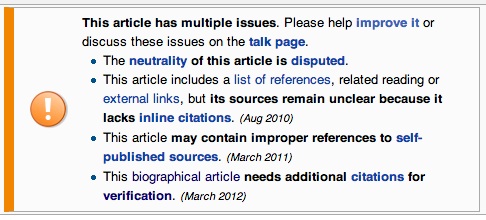
Even our students (well, mine at least, by the time they get to 8th grade) already know that the tree octopus is a hoax. The days of the static, single authored, omnipotent, must-travel-to-it website are dying. In fact, I'd say they're pretty much dead outside of webquests and things we create for our students. Instead we have dynamic, multi-authored, and boots-on-the-ground information that comes to you. And now we arrive at the one of new reliability problems.
I've been duped, probably numerous times, by the deluge of tweets that flood my timeline after a major news story breaks (a major news story according to a middle school social studies teacher looking for content and connections - sorry not sorry, royal baby). However, the one event that truly comes to mind is the Boston Marathon Bombing. Like most of the nation, and especially us here in New England, for a week straight I was glued not to my television, but to my phone. CNN and pals were too slow. All I had to do was pull down and release on my phone screen and I'd be rewarded with fifty new tweets about the topic. Many of these tweets contained misinformation, hearsay, and unverified pictures - but at the time, the in visceral rawness of the moment, none of that mattered. In fact, it never even crossed my mind for the first few days. Once it did occur to me, the idea of real time terror was something that made me step back and realize I was not as savvy a consumer as I had foolishly imagined myself to be.
This realization has not made me disavow twitter for breaking news altogether. There is most definitely something positive to be said for news in real time, from primary sources, unaltered by the mainstream media - when taken with a grain of salt. I relied on twitter for news and updates from Ferguson this past summer, Baltimore last month, and Burundi last week. While I have focused my information flow to a few reputable curators of news (most specifically Andy Carvin and the crew at Reported.ly to name a few) there still arises a new, more dangerous, problem. By getting my news from a self-selected list of people whom I trust, I have put myself soundly into a filter bubble. This is perhaps a much more harmful problem than the erroneous websites that most people associate with misinformation on the web. Within a filter bubble I have the comfort of confirmation bias and the amplified effect of an echo chamber, resulting in a steadfast belief that I am always right, which simply is not true.
Thursday, May 14, 2015
Online Collaboration Mini-Unit
Here is the link to my class website for the war theme. Here you will find all of the embedded videos I use (the cost/benefit analysis introduction and the timeline tutorial). Here is a copy of the google form the students use to collect their data. The link on the actual website won't be available to anyone outside of my school domain, therefore I made a copy of it for you to see.
Monday, May 11, 2015
Online Collaborative Inquiry
 |
| Using Google Docs in 2011 |
Effective online collaboration involves a few key components. First, everyone involved must understand that despite the digital medium - the essence is the same. One of the first things I impress upon my students each year is that there is really no major distinction between online and real life. There are certainly different aspects to how information is shared, but in the end, what you are left with is human generated content. Be it face to face or asynchronously online, communication is the same. I strive to have the same rules apply. This should always be rule number one - what you do/say/type/delete digitally you also do/say/type/delete in "real life." Framing it this way makes it easier for students to understand. I prefer to use the terms digital life and physical life as two sides to the same coin that is real life.
Let's look a google docs, for example. This is probably the easiest entry into online collaboration for students, however, if certain norms are not established - it can quickly devolve into chaos and mayhem. In order to help you avoid potential catastrophes I'll lay out just a few things to keep in mind.
- chat
- It takes kids all of 0.7 seconds to find out that a document shared between them also has a pop-out chat feature. The idea of this feature is to allow collaborators to discuss the document and plan without writing on the document itself, which can get messy very quickly. I remind kids that what they say on the chat is the same thing as saying it aloud in class. If you would not raise your hand and say it aloud in a "normal" class setting, don't say it on the chat. Just be sure that you are logged on to the chat prior to the kids (open multiple tabs if needed for each document) because unfortunately you will only be able to see what has transpired if you are on the document. There is no backlog. Lastly, depending on your style, you might want to be a tad lenient with the chat. The "real life" thing works both ways. In "real life" you know as well as I do that kids will stray from topic in face to face discussion to a degree. It is inevitable, and if we are to hold onto the real life/digital life mantra - we should hold it for all things.
- deleting other's work
- Depending on how many kids are accessing the same document, you might run into several issues. It can be very overwhelming to have multiple cursors on the same page trying to type at the same time. Imaging the physical world equivalent for a moment. How impossible and absurd would it be to have a group of several kids trying to write on a single piece of paper at the same time? Additionally, could you imagine a student erasing the work on another student's physical paper work? I'm sure it does happen from time to time, but I guarantee it does not happen with the frequency and flippancy of erasing work on a shared digital document. Online collaboration does not mean that they must all work on the same document at the same time. I frequently tell kids to open a new document for themselves and work there, then copy/paste on the shared doc and begin the process of negotiating through the editing and revising process.
- accountability & revision history
- Another benefit of using google docs with collaborative projects is the high accountability factor. You can see who contributed what to the document and when they did it. In short, you can assign grades based on actual contributions to the document. This allows the kids who always bear the brunt of the work to breathe easier knowing that their contribution will not be diluted amongst the entire group. It also lets those who typically coast by on the shoulders of peers know that their usual course of action is no longer an option. This is by no means a perfect solution for fair grading. I typically create a google form (like this one) for kids to complete at the end of a project as a supplement to checking the revision.
Here is a short video tutorial showing you the chrome extension Draftback for google docs and how it can help you visualize the edits made on collaborative documents.
Sunday, May 10, 2015
Internet as text...
To be honest, I am struggling with how to respond to this prompt. The Internet is the typical text in my classroom and it has been for several years now. This is my second year with 1:1 chromebooks, and prior to that I had a classroom set of iPods (4th generation touch). The internet has been my primary text essentially since 2011.
This is not to suggest that I am always using it as effectively as possible, and there is certainly always room for improvement. For now, allow me to explain what it is I do:
After a difficult start to a true 1:1 experience in 2013/2014 - I did some major revisions to my class over the summer. This year I attempted to have three different themes running concurrently in each of my four classes. Essentially, I embraced the idea that not everyone had to be doing the same thing at the same time - which is entirely possible when you are 1:1. If you need more proof - just look at what we (you and I) and doing right now. I'm just finishing Module 1, and most of you are on Module 2. At any rate, have a look at my syllabus and the related sites (Identity, War, Modernization)
The jury is still out on how well this worked (we have several more weeks left of the school year) - but I am leaning towards the idea that this was revolutionary for me as a teacher. This format meant there would be zero lecture time. I would launch class, the kids would work, and I would circulate and spend roughly 10 - 12 minutes with each small group engaging in discussions and clarifying misinformation. The class was socially structured, so that kids were encouraged to discuss the ideas they were working on with their group. It got loud, and to the untrained ear it might have seemed chaotic - but if you listened closely, the discussions were on point. Kids were negotiating a shared understanding and building context together. Each week they were required to submit a blog post focusing in on a particular aspect of that week's content that struck a chord with them (a link to that rubric is embedded in my syllabus above).
The most difficult part for me was simultaneously the most rewarding. At times it felt like kids were not as focused as I'd like them to be. I often wondered if they were truly getting the ideas I was hoping they'd get. I missed being the expert. I missed hearing myself talk. I missed feeling smart. Then I stepped back and stopped thinking about myself. I began to really listen to kids and to probe their understanding - and I found that most of the time they were creating their own understanding. I realized how much more powerful this is. Instead of remembering what I told them, they were making the connections on their own. These would be connections not soon forgotten because it came from them. It was theirs. They owned it, and it was this format - via the internet - that made it possible.
Subscribe to:
Posts (Atom)